



Back to Blog

    Nano Banana to Gemini Omni: The New AI Workflow for Video Ads

    TD

    Tal Dahabani

    Founder & CEO

    Published
    Updated
    Reading time7 min
    Nano Banana to Gemini Omni: The New AI Workflow for Video Ads

    The Google AI stack doesn't get talked about the way Sora once did. It also doesn't need to — because creators are shipping with it every day.

    Quick answer

    Nano Banana 2 Lite is a fast, controllable image model useful for concept boards and product frames. Gemini Omni Flash is a video generation and conversational-editing model in public preview through the Gemini API and Google AI Studio, supporting text + image + video inputs. The workflow: generate the frame in Nano Banana, animate and edit it with Gemini Omni.

    What Nano Banana 2 Lite is useful for

    Nano Banana is a fast image model that's especially strong for ad-adjacent work:

    • Concept boards on a brief.
    • Product hero frames.
    • UGC opening moments (a face, a hand, a product).
    • Environment plates.
    • Quick style tests before committing to a video generation.

    It's not the only image model, but it's one of the fastest to iterate with.

    What Gemini Omni Flash changes

    Gemini Omni Flash is rolling out via the Gemini API and Google AI Studio in public preview. What's meaningful for ads:

    • Multimodal input. Combine text + image + video to steer output.
    • Video generation for short-form ad-relevant clips.
    • Conversational editing — refine an output by talking to the model, not by re-prompting from scratch.

    For an ad pipeline, that means faster iteration and less prompt-wrestling.

    Why image-to-video and conversational editing matter

    Straight text-to-video is a lottery. Image-to-video is a workflow.

    • Start with a specific frame (Nano Banana output or product photo).
    • Give it motion direction (camera move, subject action).
    • Edit conversationally — "hold on the product for another beat," "warmer color," "cut the last second."

    That's how you get an ad, not a demo.

    From product image to a short video scene

    Step 1: Frame. Feed your product photo into Nano Banana 2 Lite. Ask for a hero frame with a specific mood, background, and light direction.

    Step 2: Animate. Pass the frame into Gemini Omni Flash with a simple motion prompt. Ask for a 4-6 second clip in 9:16.

    Step 3: Edit. Use conversational editing to refine timing, camera, or product framing. Regenerate only what's off.

    Step 4: Assemble. Add voice (ElevenLabs), music, captions, and cut for the platform.

    Prompt examples

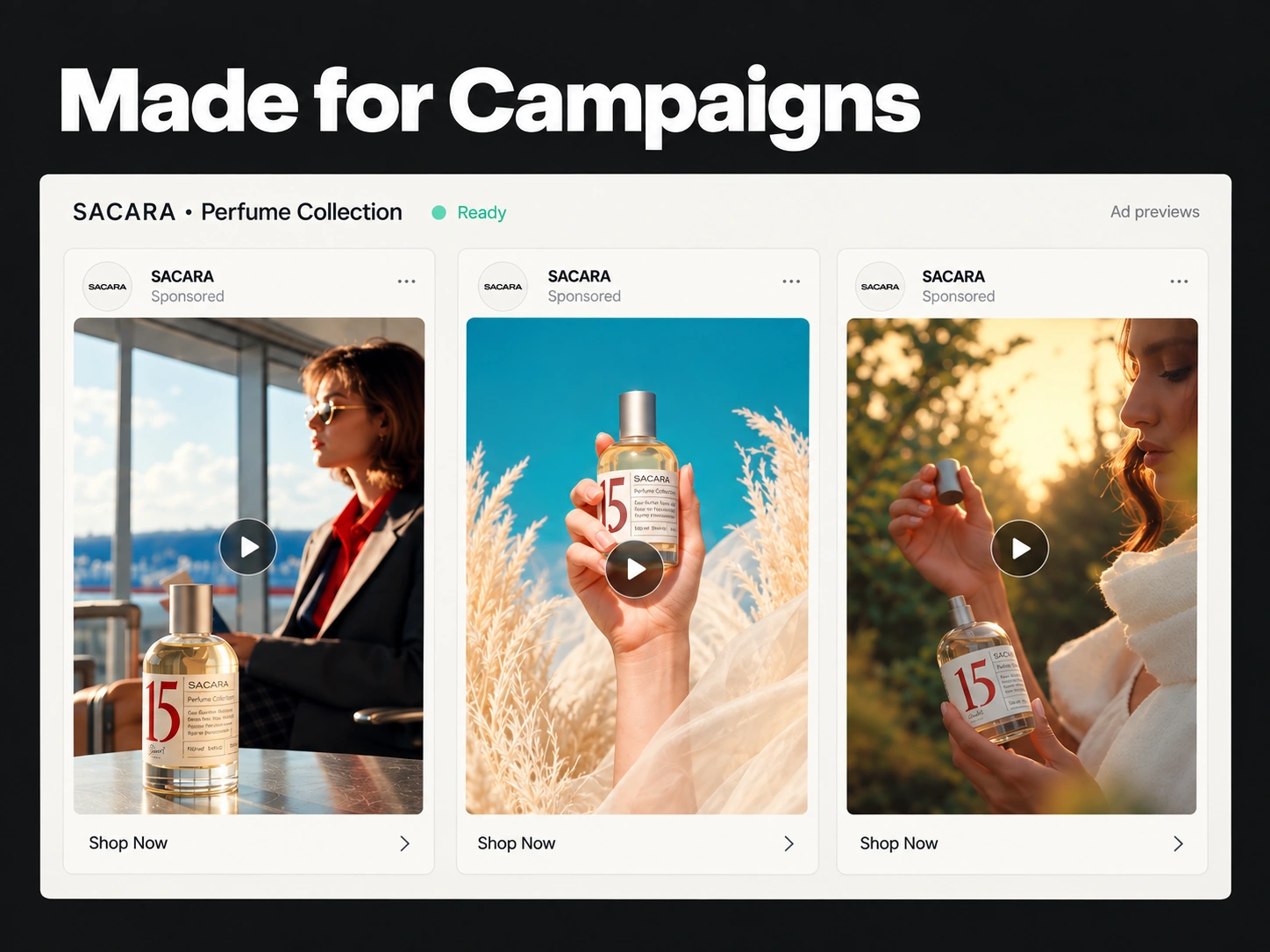
    • Product hero shot — "Studio-lit product on a matte concrete surface. Soft rim light from the right. Slow camera dolly-in. 9:16."
    • UGC opening hook — "First-person hand reveals product from a jacket pocket, morning light, handheld. 9:16."
    • Before/after concept — "Wide shot of cluttered desk transitioning to organized desk, 3-second cross-fade, natural window light."
    • Fantasy product world — "Product floating in a soft cloud environment, cinematic, but the product stays photorealistic and centered."
    • Mobile-first 9:16 creative — "Punchy hook: face reacts, then product cuts in at second 2. Vertical, high energy."

    Mistakes to avoid

    • Making a pretty image that has nothing to do with the product.
    • Forgetting the hook in the first second.
    • Over-polishing everything until it feels stock.
    • Losing product clarity because the environment is louder than the object.
    • Ignoring 9:16 framing on ads that will run on Reels or TikTok.

    AdArena workflow

    1. Write 3 concepts on the brief.
    2. Generate 3 image variations for each in Nano Banana.
    3. Animate the best 3 in Gemini Omni Flash (9:16, 4-8s).
    4. Add voice/music (ElevenLabs) and captions.
    5. Submit the strongest to an AdArena challenge.

    AdArena Take

    Google's stack is what the "just ship it" creators are quietly using. Less hype, more output.

    Frequently Asked Questions

    TD

    Tal Dahabani

    Founder & CEO at AdArena

    Tal is the founder of AdArena who believes in performance over ego. He built AdArena because he saw how the traditional agency model was broken — brands spending fortunes on content they couldn't test. His mission: help brands discover what actually works, faster than their competitors.

    Share this article

    You Might Also Like

    Get Weekly Video Marketing Insights

    Join 2,000+ marketers who get our best strategies, case studies, and AI tips every week.

    No spam, ever. Unsubscribe anytime.